The Critical Path Method: A Simple Tool to Keep Your Projects on Track
At a glance
The critical path is the longest chain of dependent activities that determines a project's earliest completion. Identify that chain, test your duration assumptions and watch delays on it closely.
1. What Is the Critical Path Method (CPM)?
The Critical Path Method is a project scheduling technique that helps you figure out which tasks matter most when it comes to finishing your project on time.
At its core, CPM is about asking:
Which tasks are absolutely essential, and what’s the shortest possible route to completion?
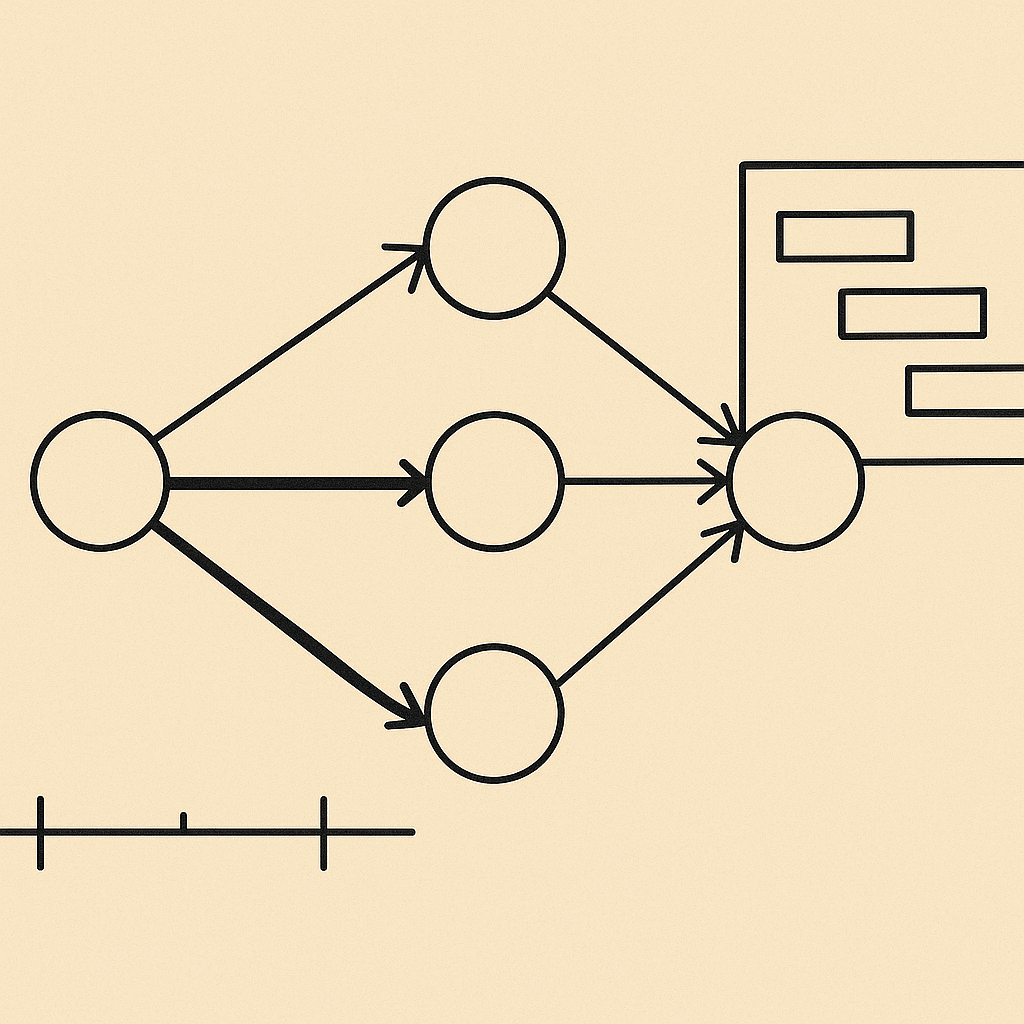
Your “critical path” is the longest sequence of dependent tasks. If any one of them is delayed, your whole project timeline shifts. These are your non-negotiables—the must-happen-on-time tasks.
2. Why Freelancers Should Care About Critical Paths
If you’re working solo, every day counts. You don’t have a team to fall back on, and shifting deadlines usually means you’re eating into another client’s time—or your own.
Here’s why CPM is actually your best friend:
- It shows you where you can afford to be flexible (and where you absolutely can’t).
- It prevents last-minute panic and missed deadlines.
- It helps you plan smarter, not harder.
This isn’t about turning into a spreadsheet robot. It’s about giving yourself a visual map, so you can confidently manage overlapping tasks, multiple clients, and your own bandwidth.
3. A Real-Life Example: The Solo Project Breakdown
Let’s say you’re a freelance web designer creating a portfolio site for a client.
Your tasks might look like this:
- Collect client assets (logo, brand guide)
- Sketch layout concepts
- Client reviews and picks one
- Build website
- Send for feedback
- Implement revisions
- Final testing
- Launch
Now imagine the client delays step 1 by a week. You can’t sketch layouts without the assets. So everything else—every single step—gets pushed back.
That’s your critical path. Those are the tasks that hold the key to your deadline.
Tasks like “final testing” may only take a day, but if they sit at the very end of a chain of dependent tasks, they can become crucial in determining your overall timeline.
4. How to Find the Critical Path in Your Own Work
You don’t need software or a Gantt chart to use CPM (although it helps!). Here’s a simplified way to do it:
- List every task in your project.
- Be specific—don’t just say “design.” Break it into steps.
- Identify dependencies.
- What tasks depend on another being done first?
- Estimate how long each task will take.
- Ballpark it. This helps you figure out which sequences are longest.
- Trace the longest sequence of dependent tasks.
- That’s your critical path.
If any task in that chain gets delayed, the final delivery date will too.
5. Avoiding Common Timeline Traps
The biggest mistake freelancers make? Assuming all tasks have equal weight.
Some tasks are flexible. Others are fixed. Knowing the difference is what sets apart reactive freelancers from proactive ones.
Using CPM helps you avoid traps like:
- Underestimating how one small delay ripples into the whole schedule
- Overloading yourself because you didn’t factor in task order
- Assuming tasks can be done “whenever” when they’re actually time-sensitive
6. What If Things Shift? Flexibility in Freelance Planning
Life happens. Clients ghost. Tech breaks. Your dog eats your router cable.
Good news: CPM isn’t rigid—it’s a map, not a prison. If things shift, you update the critical path. That’s the point. It shows you what’s negotiable and what’s not.
Use it like a GPS. If there's traffic on one route, you can re-route—but at least you know what you're adjusting and why.
7. Use CPM Without Overwhelm with ProjectBook.co
ProjectBook.co is built for solo professionals who want clarity without complexity.
Here’s how it supports the Critical Path Method in a freelancer-friendly way:
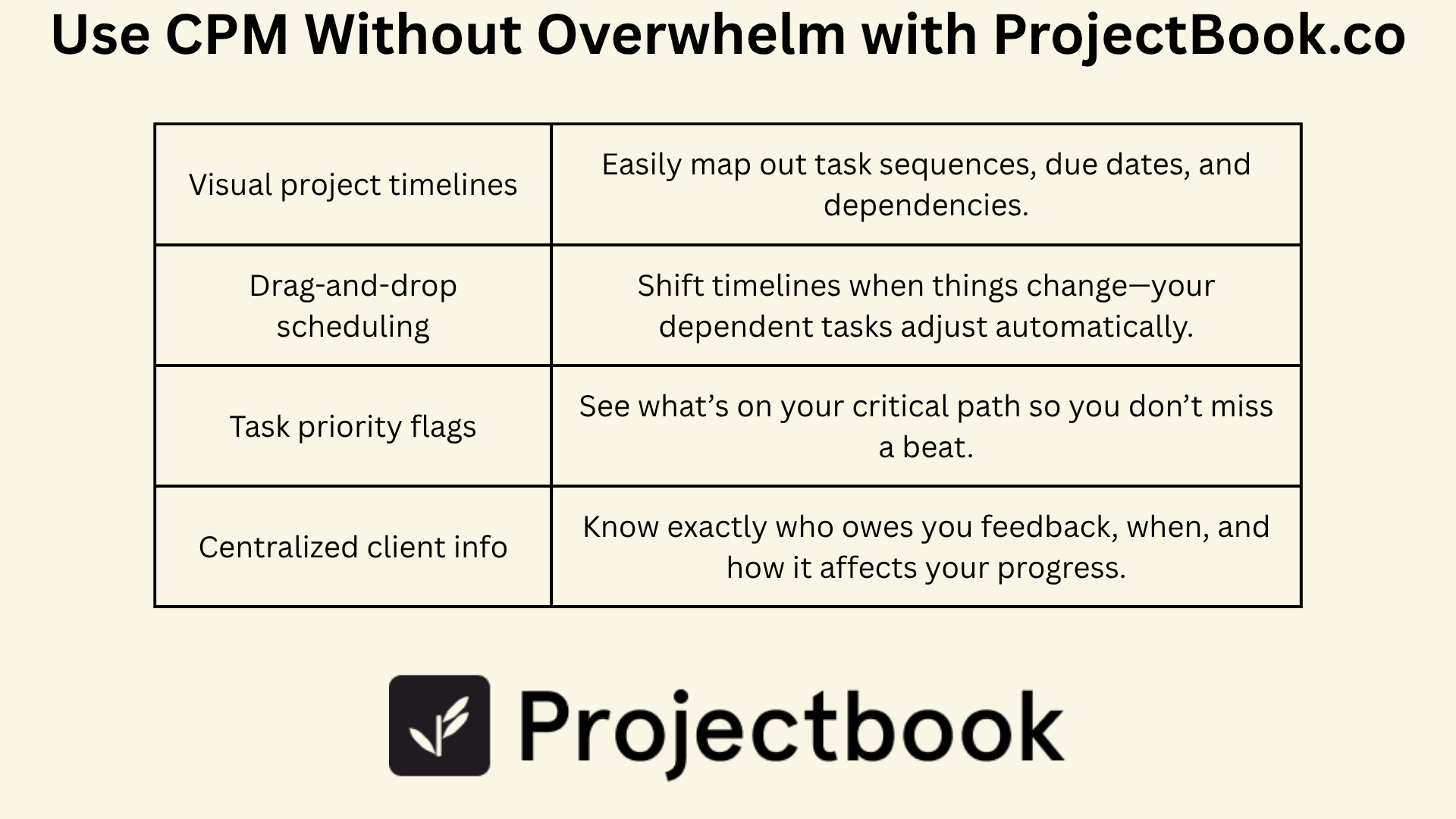
- Visual project timelines: Easily map out task sequences, due dates, and dependencies.
- Drag-and-drop scheduling: Shift timelines when things change—your dependent tasks adjust automatically.
- Task priority flags: See what’s on your critical path so you don’t miss a beat.
- Centralized client info: Know exactly who owes you feedback, when, and how it affects your progress.
Whether you’re launching a brand, building a website, or delivering a coaching program, ProjectBook keeps your plan grounded—and your stress levels low.
8. FAQ: Critical Path Method for Freelancers
Q: Do I really need to use this on every project?
Not always. But for projects with multiple steps, clients, or collaborators—it’s a huge help. Even a simplified version makes a difference.
Q: How do I explain this to clients without sounding technical?
Keep it simple: “Some steps depend on others being finished first. That’s why I need X from you by [date], or we risk missing the launch.”
Q: What tools help with CPM?
You can use pen and paper, a whiteboard, or a project management tool like ProjectBook.co that lets you see task flow and adjust on the fly.
Q: What if my project doesn’t have clear steps yet?
That’s a sign to do a mini pre-plan. Even a rough outline of tasks helps you estimate time, set expectations, and reduce surprises.
Final Word
You don’t need to become a certified project manager to use the Critical Path Method. You just need to get a little more strategic with how you plan your work.
When you understand which tasks carry the most weight, you can make better decisions, set smarter deadlines, and keep your projects running smoothly—even when life gets messy.
Try building your next project timeline in ProjectBook.co, and see how much easier it feels to stay on track when you’ve got clarity from the start.
From ideas to a clearer week